In its earliest form, wound care mainly consisted of applying a variety of herbal mixtures to the wound, many of which we now understand aided in healing due to their antiseptic and anti-inflammatory properties. The ancient Greeks, Romans, and Egyptians also displayed an understanding for the necessity of covering and closing a wound to promote healing. They began incorporating thick and stick ingredients into their herbal mixtures, such as honey and clay, to create a sort of primitive bandage.
No significant advancements in wound treatment were made until the 19th century, when physicians began to understand microbiology and the concept of “germs”. The introduction of simply practices, many of which we now take for granted such as hand washing and sterilizing surgical equipment and would dressings, greatly decreased the rate of wound infection and lead to faster healing times.
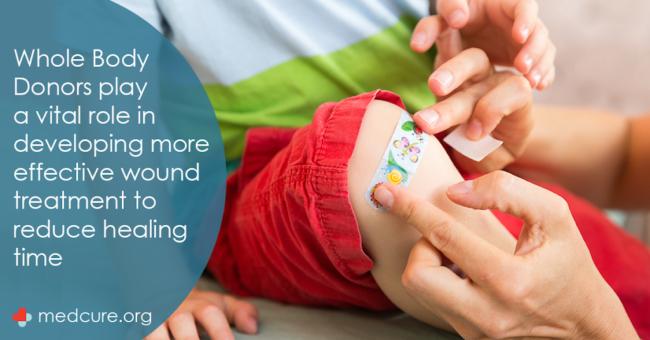
The field of wound treatment has evolved at an exponential rate since the 19th century. The past 200 years has seen simple additions, such as the invention of the adhesive bandage and the introduction of easily acquired household antiseptics, to more advanced innovations, such as using fish skin to cover burns or manipulating regenerating skin cells to eliminate scarring. And, like any other aspect of medicine, we have yet to reach our full potential.
Researchers are continuing to search for improved methods for treating and healing wounds. If you are interested in learning more about whole body donation and the role that it plays in advancing medical science, you can visit our website at https://medcure.org/donor. Or, you can call our 24/7 toll free number 866-560-2525 to speak with one of our knowledgeable Donation Coordinators.